
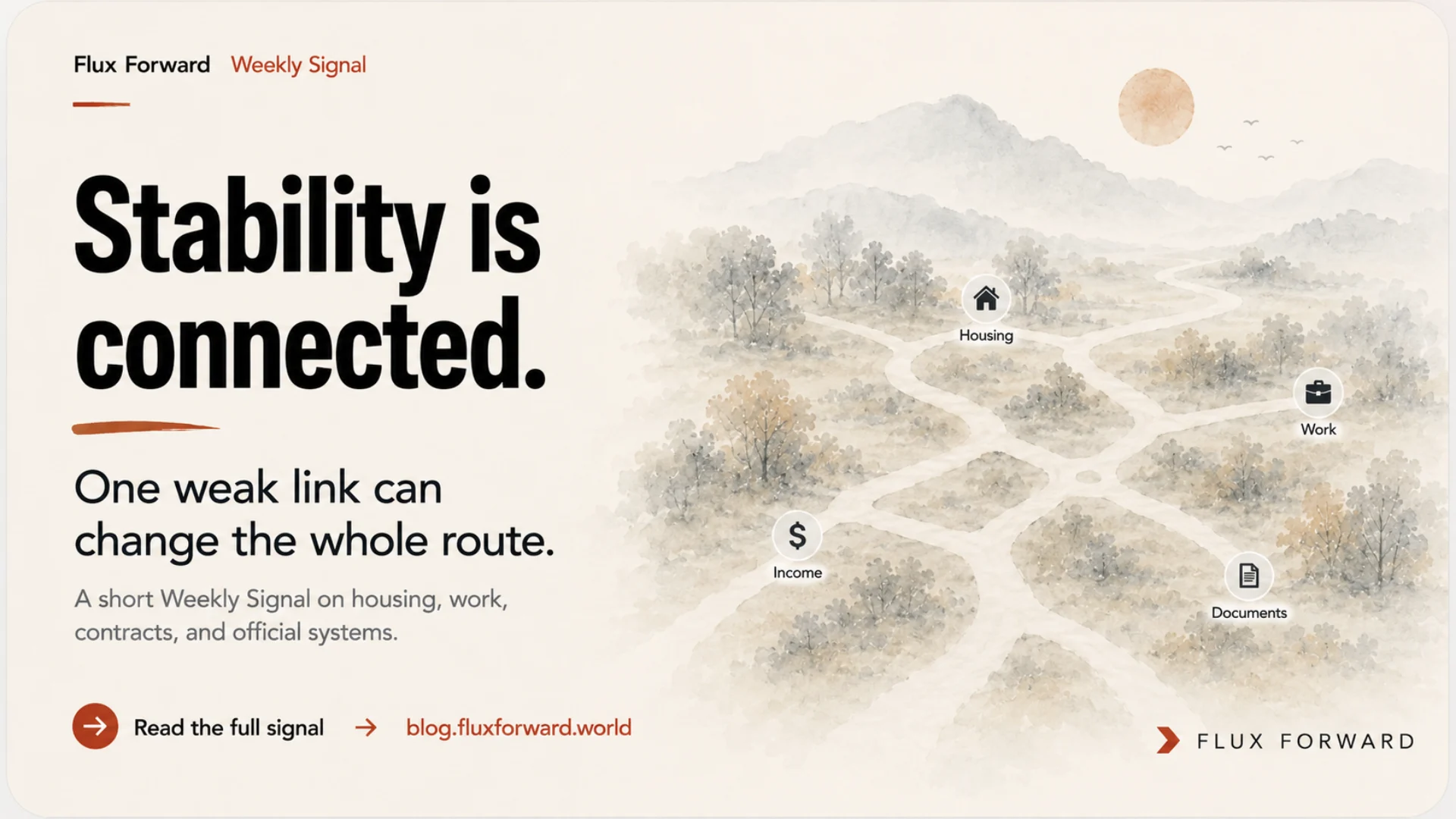
One weak link can change the whole route.
A practical weekly signal for international students, skilled workers, graduates, and founders in the Netherlands.
You may have the job, but not the housing.
You may have the room, but not the registration.
You may have the internship, but no clear pay or agreement.
You may receive an official letter and still not know what it means for you.
For internationals in the Netherlands, stability is rarely about one thing.
Housing, work, income, contracts, documents, registration, and official decisions often affect each other. When one part becomes unclear, the pressure can quickly spread to the rest.
This week’s signal is simple:
Stability is connected.
What we noticed this week
Several public signals pointed in the same direction.
Private-sector rents went up again. More homes came onto the market, but the housing shortage is still there.
At the same time, there were new signals around flexible work, internship pay, workplace safety, and job cuts in Dutch tech.
There was also more reporting about migrant workers whose housing depends on their employer or agency.
These may look like separate stories, but they all point to the same problem:
A situation can look stable from the outside while depending on something fragile underneath.
Housing and work are often connected
Housing is a good example. For some internationals, housing depends on a job, an agency, a contract, a salary, or a work location.
If the job ends, the room may also disappear.
If the contract is unclear, it may be harder to show enough income for housing.
If the commute is too long, a job may not be realistic.
It also works the other way around.
A housing problem can affect registration, BSN, insurance, banking, university admin, travel, and where you can work.
That is why “find housing” and “find work” are not always two separate steps.
Sometimes the better question is:
What depends on what?
Does the room depend on the job?
Does the job depend on living nearby?
Can you register at the address?
Does your residence situation depend on one employer or contract?
The more connections there are, the more important it is to see them early.
A job title does not tell you everything
A role may look like a good opportunity, but the title alone does not tell you:
- whether your hours are guaranteed;
- whether the income is predictable;
- whether the contract is temporary, permanent, on-call, or freelance;
- whether the employer controls another part of your situation;
- whether the role may change because of restructuring or AI;
- whether an internship has clear pay, supervision, and learning value.
This does not mean you should distrust every employer or contract.
It means you should understand what you are saying yes to.
A useful opportunity should not turn into a hidden dependency later.
Official systems can also create instability
Sometimes the weak link is not a job or a room. Sometimes it is a letter.
A deadline.
A fine.
A municipality message.
A permit rule.
An official update that is hard to understand.
When that happens, it is not “just admin”.
It can affect your money, your confidence, your access to services, and your ability to focus on study, work, or your business.
You do not need to understand the whole Dutch system at once.
Start with a few basic questions:
- Who sent the message?
- Does it apply to you?
- Is there a real deadline?
- What happens if you do nothing?
- Where can you check the next step?
Once the situation is clearer, the next move usually becomes smaller.
The signal is different for each route
For an international student, stability may depend on housing, registration, money, university admin, internship conditions, and support.
For a graduate or skilled worker, it may depend on the contract, income, employer, residence status, housing, and the ability to change jobs.
For a founder, it may depend on personal savings, housing costs, admin, business pressure, and enough stability to keep building.
The country is the same.
The dependency chain is not.
That is why one general checklist is often not enough.
One practical question
Before making your next decision, ask:
Which part of my stability depends on something I do not control?
For example:
Does your housing depend on your employer?
Does your residence situation depend on one contract?
Does your internship depend on promises that are not written down?
Does your financial plan depend on rent staying the same?
Does your next step depend on a letter you do not fully understand?
You do not need to remove every dependency.
Some are normal.
The point is to know which one could affect everything else.
Then the next step may be simple:
check the contract;
confirm that registration is possible;
save the letter or message;
ask the right support point;
make a backup plan;
or wait until a proposal becomes an actual rule.
Dutch phrase of the week
“Waar hangt dit van af?”
This means:
“What does this depend on?”
It is a useful question when something looks clear, but the situation underneath it is not.
Not: “How do I solve everything?”
But: “What is this next step depending on?”
Flux Forward
Flux Forward helps internationals in the Netherlands understand what is stuck, see which systems are connected, and choose one practical next move.
If you are not sure which part of your situation is creating the most pressure, start with the Activation Scan:
https://scan.fluxforward.world
Once the main signal is clearer, use the Flux Forward Guides to check the next practical step:
https://fluxforward.world/guides
You can also continue in the Flux Forward App, save your result, and reflect on your next move:
Stability is connected.
Sometimes the best next step is not fixing everything. It is finding the weak link before it affects the rest.